
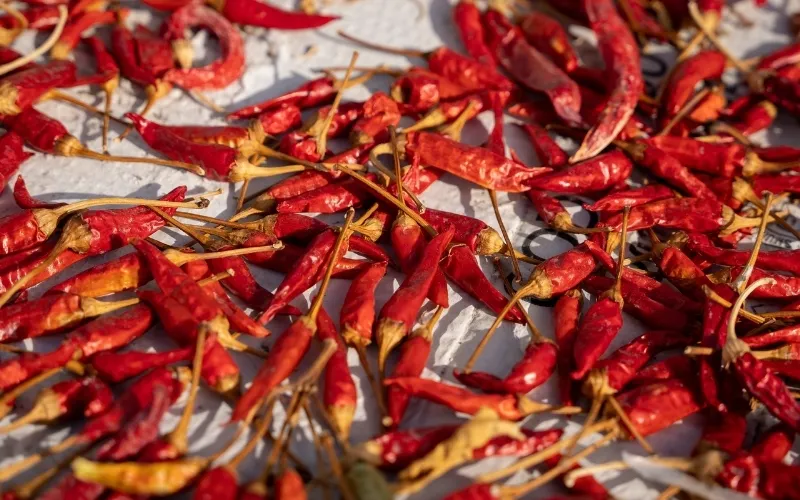
When you buy dried chiles by volume, "quality" is not a marketing buzzword: it determines how far your purchase goes, how much waste you will throw away, and how much you should be paying per kilo. Understanding how chile is graded lets you order exactly the grade your business needs, without overpaying for a quality you will not take advantage of.
What defines the quality of a dried chile?
There is no single standard across the entire market, but serious buyers and suppliers evaluate chile using the same criteria. Quality is built from several factors that, together, define the commercial grade and the price:
- Color: a vivid, uniform color indicates good drying and storage. Dull tones or spots usually signal old or poorly stored product.
- Moisture: a chile that is too moist weighs more (you are paying for water) and develops mold; too dry and it cracks and generates dust. The right moisture level protects yield and shelf life.
- Cleanliness: presence of dust, dirt, stems, loose seeds, or foreign matter. Greater cleanliness means less waste during processing.
- Pod integrity: proportion of whole chiles versus broken or fragmented ones. Whole pods are worth more for presentation; broken ones can work well for grinding.
- Size and caliber: uniformity of size. This matters a great deal when the chile is sold whole or used for stuffing.
- Damage: chiles with insect bites, sun burns, or mold. These lower the grade immediately.
1st, 2nd, and 3rd quality: what to expect from each
The classification by "first," "second," and "third" is the practical way the wholesale market summarizes all those factors into a single grade. In broad terms:
| Grade | Typical characteristics | Recommended use |
|---|---|---|
| 1st quality | Intense, even color; whole pods; high cleanliness; controlled moisture; very low waste. | Product displayed whole, brands that prioritize presentation, export. |
| 2nd quality | Good color with some variation; mix of whole and broken; acceptable cleanliness. | Salsas, adobos, moles, and high-volume cooking where the chile is ground or cooked. |
| 3rd quality | Duller color; higher proportion of broken pods and loose matter; more waste. | Industrial grinding and processes where only pulp yield matters. |
Important: the criteria change depending on the variety (guajillo, ancho, pasilla, mulato, arbol...) and the supplier. That is why, before closing a deal, it is advisable to confirm against a sample exactly what each grade includes.
The most expensive mistake: buying more quality than you need
If your end product is a ground sauce, paying for 1st quality only to grind it down is giving away margin. Conversely, if you sell the chile whole for the customer to see, a 3rd quality batch with too much breakage will cost you complaints and returns. The "right" quality is the one that matches your end use, not the highest possible grade.
Three questions before ordering a grade
- Will the chile be seen whole, or will it be ground or cooked?
- How much waste can your process absorb without affecting cost?
- Do you need uniformity in color and size, or just pulp yield?
How to verify quality upon receiving
The grade is agreed at purchase, but confirmed upon delivery. A quick inspection saves you from surprises:
- Compare against a reference sample agreed upon with the supplier.
- Check color and smell: the chile should smell like chile, not like moisture or mold.
- Take several pods and check for breakage, dust, and foreign matter.
- Ask about the packaging (bulk, 10 kg sack, or 20 to 25 kg sack depending on variety) and verify the weight.
Explore our dried chiles
Browse the varieties and quality grades we carry at wholesale before requesting your quote.
View dried chiles